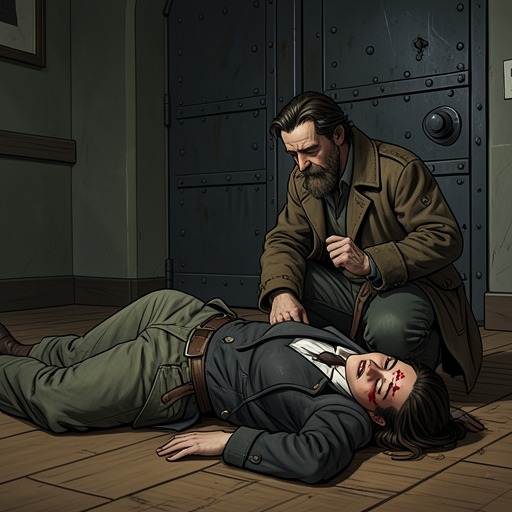
Mrs. Joe Gargery's death
Great ExpectationsMrs. Joe Gargery's death is reported to Pip as the close of a life altered by violence and prolonged disability. Her final lucid moments bring her back into speech and into intimate contact with Joe, while the news reaches Pip through a formal funeral notice; Biddy's fuller recollection makes the death an emotional reckoning with the home and relationships from which Pip had grown distant.
Notice and Return
Pip learns of his sister's death through a letter signed TRABB CO. It states that Mrs. J. Gargery died on Monday evening at twenty minutes past six and asks him to attend her burial the following Monday at three in the afternoon. The businesslike wording gives the news with little ceremony, but Pip experiences it as the first grave opening in the road of his life. The familiar image of his sister in her chair by the kitchen fire returns insistently, and he imagines her approaching him in the street or knocking at his London door, places in which she had never been part of his life.
That sudden presence in memory follows a separation already marked by guilt. When Pip first left home, Joe and Biddy threw old shoes after him in farewell; once beyond the village, he broke into tears and recognized his ingratitude. Later, during Joe's visit to London, Pip was impatient with his awkwardness and failed to understand that his own reserve had made Joe uncomfortable. Remembering that exchange after the death notice, Pip sees how poorly he had answered Joe's gentleness. The death makes absence irreversible, but also sharpens his awareness of the affection he had taken for granted.
Biddy's Account of Her Last Hours
Pip asks Biddy for the particulars. She explains that Mrs. Joe had been in one of her bad states for four days, although such episodes had lately improved rather than worsened. At teatime one evening, she emerged from the state and spoke plainly for the first time in a long while: she said Joe's name. Biddy fetched him from the forge, then followed her sister's signs, which asked Joe to sit close and Biddy to place Mrs. Joe's arms around his neck.
Resting against Joe, Mrs. Joe appeared content and satisfied. She said Joe's name again, then spoke once of pardon and once of Pip. She did not lift her head again. An hour later, Biddy and Joe laid her on her own bed and discovered that she was dead. The sequence is spare but intimate: after years in which speech had been absent, her final words name the two men bound to her household and the forgiveness that had been missing from her relationship with Pip.
Relationships and Reconciliation
The last scene centers on Joe's care rather than on any explanation of the earlier violence. Mrs. Joe asks for his nearness, and he becomes the support against which she settles in her final moments. Biddy's account makes her final gesture an act of bodily closeness and apparent peace, not a dramatic speech or a formal reconciliation. Her repeated naming of Joe gives their marriage a tenderness visible at the point of death, while her single word of pardon leaves the meaning open: the narrative records the word but does not specify its object.
Pip's name is the final personal link in the account. Biddy says Mrs. Joe spoke it once, but does not claim to know what she meant or whether she intended a particular message. For Pip, however, hearing that name among his sister's last words intensifies the loss. His own memory of leaving home and of treating Joe stiffly in London frames the report with remorse; her death cannot repair that conduct, but her last words place him within the family bond from which he had tried to distance himself.
Narrative Form and Significance
The event is narrated retrospectively through Pip, but its most consequential details arrive in Biddy's quoted recollection. The formal notice supplies the date and time; Biddy supplies the gestures, the recovery of speech, and the order of the last words. This movement from impersonal announcement to personal testimony changes the death from a fact to an intimate scene, while Pip's tears and memories show how the account alters his understanding of his past.
The death also closes a painful arc without pretending that suffering has been undone. Mrs. Joe's final composure and request for closeness contrast with the harshness associated with her earlier role in Pip's childhood, but the narrative neither erases that history nor turns her last words into a complete explanation. Instead, the quiet details—Joe fetched from the forge, her arms placed around his neck, and the names spoken after a long silence—make the ending an understated moment of connection. For Pip, the loss exposes the cost of estrangement and gives renewed weight to the loyalty he had failed to value while his sister was alive.